This website is Registered under the Private Travel Agency name Seven Safar Tour & Travels. We organize Hotel, Safari and Tour Package bookings in Kanha National Park.
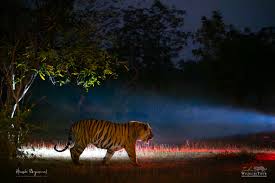
Kanha National Park is one of the largest tiger reserves in central India and is known for its wildlife rescue facilities. It was a painstaking task for the forest officials and the rescue team to catch the injured leopard that was spotted in the Balaghat district of Madhya Pradesh. The leopard was found in a distressed and injured condition. As soon as the locals spotted the leopard, they informed the nearby forest department office. This news spread like wildfire, and a large crowd gathered at the spot where the leopard was spotted. This further complicated the task for the forest officials. The officials had to handle the crowd and the situation while also coordinating with the rescue team to catch the leopard without further injuring it. The fact that it took them 12 hours to catch the leopard tells you how carefully the officials had to handle the situation.
What the rescue team discovered about the leopard's condition
Once the leopard was safely caught, the animal was examined on the spot by the forest veterinarians. The animal had sustained injuries, and the condition of the animal required more than basic treatment. In view of the seriousness of the case, it was decided to shift the leopard to Kanha Tiger Reserve, located at Mandla. It has the required facilities as well as the expertise of wildlife veterinarians. Kanha National Park has always been the hub of wildlife rescue and rehabilitation centers of Madhya Pradesh. The case of the leopard has now been handed over to the expert team of Kanha Park. The leopard has been shifted, taking care not to add more stress to the already weakened animal.
Why Kanha National Park was chosen for treatment
Kanha Park is one of the best-managed tiger reserves in the country and extends over the forests in the Mandla and Balaghat districts. The rescue and rehabilitation facilities are among the best in central India, and this is the reason why injured wildlife from the surrounding areas is often brought here for treatment and care. The decision to shift the Balaghat leopard to Kanha National Park was not just a pragmatic one but a necessary one as well. The proximity of Balaghat to the Kanha habitat is a significant factor in this regard, as it is likely that this leopard is a part of the same forest corridor as Kanha.
Conclusion
This is a clear reminder of how active and interconnected the wildlife landscape is in and around Kanha National Park. Leopards are very adaptive and can travel beyond the periphery of the forests into the buffer areas, farmlands, and even village peripheries. When they get injured, it is the speed and efficiency of the rescue operation that makes all the difference between life and death. The Balaghat Forest Department and the Kanha Rescue Team should be complimented for their perseverance and never-give-up attitude over the grueling 12-hour rescue operation. In the future, if better monitoring of the forest peripheries and faster rescue operations can be put in place, and awareness is created among the villagers about whom to contact if they spot any wildlife in distress, such situations can only be prevented from becoming worse.
.jpg)
 (1).jpg)
.jpg)
.jpg)
.png)